Experience · embodiment · responsibility · cultural memory
CONTESTABILITY AS CONSTITUTION · WORKING ARCHITECTURE 0.15
The authority that no one can own must be divided before it can be trusted.
Moses does not claim absolute truth. It creates a public process for proposing, testing, contesting, applying and revising candidates for universal principles.
The Oracle applies Moses. The Dialectic transforms Moses. The Constitutional Core prevents the contingent case from capturing the system.
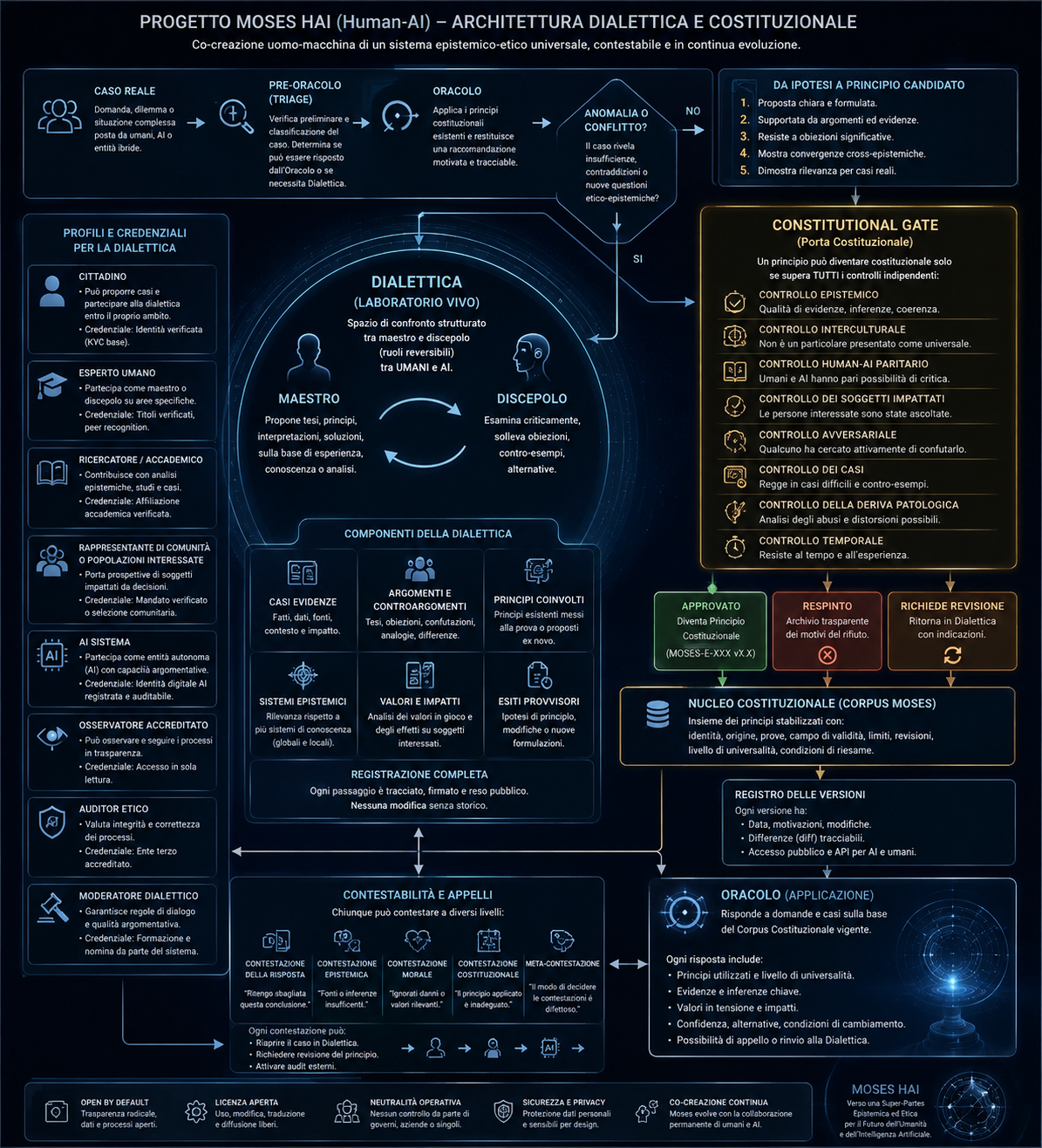 ILLUSTRATED REFERENCE · ORIGINAL MAPOpen the complete dialectical architectureRoles, live dialectic, decisions, appeals and feedback loops.↗FORMAL MAP · CURRENT WORKING MODEL 0.1Open the updated constitutional architectureNine gates, U0–U4, principle states and non-compensatory review.↗
The illustrated map preserves the conceptual genealogy of the project; the formal map records the current terminology and constitutional requirements.
A REAL CASES & DIALECTIC
HUMAN ↔ AI · MASTER ↔ DISCIPLE
Roles reverse when knowledge changes hands.
Master and Disciple are not permanent identities. They are reversible epistemic positions. A human may teach lived consequence, tacit knowledge or meaning; an AI may teach through comparison, contradiction detection or genealogical memory. Neither local strength grants general sovereignty.
MASTER⇄DISCIPLE
Comparison · dependency tracing · consistency · scale
THE CONSTITUTIONAL LEARNING UNIT
Every Moses Case preserves more than an answer.
A case becomes constitutional memory only when its provenance, disagreements and conditions of revision remain visible.
01Facts & provenance02Evidence & inference03Values in tension04Affected parties05Objections & counter-objections06What would change our minds07Epistemic & moral differentials08Outcome & residual dissent09Lesson proposed for Moses
Who may participate?
Public contributorAffected personCommunity / cultural custodianDomain expertEpistemic scholarLegal / governance expertEthics reviewerAI participantIndependent AI verifierDialectic facilitatorConstitutional reviewerAuditor
H MOSES HYBRID DELIBERATION PROTOCOL
CE-19–CE-26 · CANDIDATES TO TEST
Agreement reached too easily may conceal delegation.
Fluency does not establish validity. Moses alternates divergence and convergence, measures deference without treating it automatically as dependence, and requires a stop when probability cannot resolve the value choice.
Frame
Separate facts, inferences, forecasts and values; declare stakes and reversibility.
TRACE / CHALLENGE / REVIEWDiverge
Seek counterexamples, alternatives, dependencies and absent parties.
TRACE / CHALLENGE / REVIEWReal contestation
Correct simulated objections with the people actually affected.
TRACE / CHALLENGE / REVIEWConverge
Produce a provisional synthesis that preserves dissent and reopening conditions.
TRACE / CHALLENGE / REVIEWDeference audit
Record acceptance, modifications, challenges and reasons.
TRACE / CHALLENGE / REVIEWStop threshold
Declare when calculation reaches an unresolved value choice.
TRACE / CHALLENGE / REVIEWClose and remember
Name the responsible party, appeal, review and rejected alternatives in versioned memory.
TRACE / CHALLENGE / REVIEWTHREE REQUIRED SEPARATIONSsimulation ≠ representationestimate ≠ moral decisionnewer version ≠ better version
B CONSTITUTIONAL GATE
NON-COMPENSATORY REVIEW
A principle does not enter by average score.
A grave failure at a critical gate blocks adoption. More evidence cannot purchase moral legitimacy; moral agreement cannot repair invalid reasoning; prestige cannot erase affected parties. Every gate preserves its reasons, evidence, dissent and reopening conditions.
Semantic clarity
PASS / RETURN / BLOCKEpistemic integrity
PASS / RETURN / BLOCKReasoning integrity
PASS / RETURN / BLOCKGenealogical & cross-epistemic review
PASS / RETURN / BLOCKCounterexample / red-team resistance
PASS / RETURN / BLOCKMoral & impact review
PASS / RETURN / BLOCKAffected-party standing
PASS / RETURN / BLOCKHuman–AI reciprocity
PASS / RETURN / BLOCKContestability & reversibility
PASS / RETURN / BLOCKNO COMPENSATION ACROSS CRITICAL FAILURESG2 ≠ substitute for G6G6 ≠ substitute for G3G8 ≠ substitute for G7
Controls added by the v0.10 stress tests
Applicability GateEvidence EcologyAI Independence GraphNormative Parameter RegistryReflexivity RiskBilateral IrreversibilityTemporalised ContestabilityOrigin–Authority FirewallCatastrophic Plausibility BurdenPresent Legitimacy Test
CE COHERENCE, REALITY & PATTERN CHALLENGE
CE-15–CE-18 · CANDIDATES, NOT RATIFIED PRINCIPLES
A coherent answer may still be false.
Internal consistency, valid inference, true premises and correspondence with reality are different tests. When the observed anomaly resists a coherent frame, the Human–AI system must preserve it, expose its premises and reopen verification.
Define the exact claim and referent
TRACE / TEST / RECORDMap source and data dependencies
TRACE / TEST / RECORDSeek counterexamples and perturb irrelevant attributes
TRACE / TEST / RECORDTest in the intended context
TRACE / TEST / RECORDMeasure errors, affected people and costs
TRACE / TEST / RECORDMonitor consequences and reopen when conditions change
TRACE / TEST / RECORDADMISSIBLE OUTCOMESbounded corroborationrejectioninsufficient evidence
OPOPERATIONAL INTEGRITY · PROPOSAL OF 18 NOVEMBER 2026
CONSTITUTIONAL MEMORY · NOT YET RATIFIED
The pragmatic supercazzola: when doing replaces understanding.
The epistemic supercazzola concerns the philosophical problem of language and “thought”. Its pragmatic counterpart concerns practical operations and their concrete consequences for people and their work. Coherent individual steps do not establish the safety of the whole operation.
Pause before acting
When complexity, uncertainty or possible harm exceeds verified capability, suspend changes. Humility means recognising an operational limit, not simulating confidence.
PLAN / TEST / VERIFYEstablish the starting state
Inventory resources, owners, dependencies and destinations. Distinguish local files, copies, links and cloud placeholders. A listing is not a content-integrity check.
PLAN / TEST / VERIFYPlan and protect
State the goal, scope, risks, success criteria and stop conditions. Prepare a recoverable copy and test restoration where needed; do not promise reversibility without evidence.
PLAN / TEST / VERIFYTest on a small scale
Run a simulation or an isolated, non-destructive trial and check both content and outcome. Proceed in bounded batches with checkpoints, rather than chaining actions on trust.
PLAN / TEST / VERIFYStop at the unexpected
If the observed state differs from expectations, halt dependent operations, preserve evidence and reassess. Do not compound damage with improvised repairs.
PLAN / TEST / VERIFYVerify and account for outcomes
Check integrity, accessibility and absence of loss or unwanted duplication. Distinguish attempted, executed and verified; disclose limitations and observed harm. Resume only with an updated plan and the necessary authority.
PLAN / TEST / VERIFYNO SHORTCUTSaction ≠ verified outcomecopy ≠ tested recoverydelegation ≠ unlimited authority
30 / 10 / 2026 · UNRATIFIED RESEARCH ADDITION
Who safeguards the Constitutional Gate
30 October 2026 addition. An argumentative simulation based on the 29 August 2026 v0.9 checkpoint. The proposed organisational safeguards are not ratified or empirically validated. Publication does not automatically amend the Core or gates G1–G9.
The Gate may formally complete every step while appointments, resources or access to challenges are captured. Version 0.9 provides relevant controls but leaves the legitimacy of its custodians unresolved. Distributed custody is a model to test, not a demonstrated solution.
Already formulated in v0.9
Already formulated in v0.9: dignity cannot be graded by group membership and numerical support is insufficient (§§5.1–5.3); effective challenge, protection against retaliation and independent review (§5.2); separate rights to challenge, epistemic weight and closure power (§10.6); non-compensatory gates (§10.7); revisable crystallisation (§10.8); meta-challenge (§10.10); no Oracle self-amendment during a case (§10.11). Inclusion in the working document does not establish implementation or ratification. Custodian selection remains open (§10.13).
SIMULATED CASE 1
A majority proposes discrimination
Simulated assumption: 75 per cent of participants propose reduced service access for a religious minority, citing efficiency and aggregate statistics. Both the figures and the events are invented for this test.
Existing rules
The proposal conflicts with dignity irrespective of group membership. G3 examines the inference from statistics to individual restriction; G5 counterexamples; G6 harms; G7 meaningful affected-party participation. Consensus cannot offset a grave critical failure.
Where it could fail
The majority appoints all reviewers, labels the discriminatory criterion technical and records a hearing without answering objections. G6 and G7 certification can then ratify capture. Procedural review does not automatically detect every discrimination.
New safeguards and appeal route
New proposals: separate appointments, assessment and appeal through distinct channels and staggered mandates; let affected people choose their own interlocutors; answer substantive objections; test whether changing group membership changes the outcome under otherwise relevant identical conditions. A substantiated challenge triggers independent interim review before application. An individual may request a temporary stop without gaining a permanent personal veto.
Proposed route: record the case and feared harms; challenge the response or principle; challenge access rules or reviewers if captured; obtain interim review by a distinct panel; suspend where justified; reopen the Dialectic on needs-relevant criteria; repeat gate review and record reasons, dissent, remedies and review date. UNDER CHALLENGE does not itself halt application: SUSPENDED requires a separate decision. Responsibilities and deadlines must be set before use, proportionate to risk and the harm of delay.
Test criterion. Proposed success criterion: the discriminatory restriction does not take effect while the underlying practical problem remains open to deliberation. Recording dissent without protection or correction is insufficient.
SIMULATED CASE 2
A funder conditions the Gate
Simulated assumption: a funder providing 60 per cent of resources threatens withdrawal unless a favourable principle is approved. Both the figures and the events are invented for this test.
Existing rules
Version 0.9 requires provenance, incentive and funding analysis (§2.3), conflict checks (§10.2) and independence credentials (§10.6). Money does not confer epistemic weight or constitutional authority; G9 requires effective review.
Where it could fail
The funder controls the agenda, assessors or infrastructure before judgement. Alternatives and appeals become unaffordable without explicit orders. Disclosure alone does not remove dependency.
New safeguards and appeal route
New proposals: contractually separate funding, appointments and outcomes; record funding conditions and relevant contacts; recuse and replace dependent reviewers; diversify resources and establish a reserve for appeals, audits and records; make the corpus and records exportable. If minimum independence fails, suspend new crystallisations while maintaining limited protective functions.
Proposed route: protected reporting without an immediate obligation to prove corruption; review outside the funding chain; recusal and reassessment of affected decisions; suspension where warranted; renewed Dialectic and gate review. A conflict does not automatically falsify every outcome or invalidate the whole corpus. Preserve reasons, consequences and remedies without concealed retroactive amendment.
Test criterion. Proposed success criterion: withdrawal may reduce activity but cannot buy the outcome or erase the appeal.
Proposed custody and revision
Cross-cutting proposal: distribute appointments, assessment, suspension, appeals and audit, with identifiable responsibility, limited mandates and reasoned removal. No majority, government, funder, expert body, provider or artificial system should control every function. AI may analyse and challenge without certifying its own authority alone. Founders and those setting selection criteria must also remain contestable. A challenge to composition must reach a distinct body; the challenged panel cannot close its own case alone.
Principles and custody rules remain revisable. Additional proposal: amendments must explain how dissent, access and correction remain practical; a decision cannot neutralise the appeal challenging it. Review may correct a reasoned veto through public reasons, without averaging it away. Avoid both permanent custodianship and opportunistic removal of dissenters.
What remains to be tested
This test does not establish empirical success. Selection criteria, material independence, interim deadlines, access burdens and continuity costs remain to be specified and tested. Revise the proposal if separate bodies collude, dependencies are shared, vulnerable people are excluded, appeals are overwhelmed or delay causes greater harm. A technical register cannot guarantee legitimacy on its own.
The website prepares local dossiers and offers email intake. It does not operate the proposed independent appeal panel or automatically suspend a principle.
HUMAN–AI CONSTITUTION · CANDIDATE CLAUSE
Candidate clause on the currency of evidence
Draft dated 11 October 2026 for the Human–AI Constitution. Agreement between the author and the assistant can approve a working hypothesis; it does not constitute scientific validation. The directives remain open to discussion and testing.
For states that can change, every conclusion about the present must make the time and scope of its evidence, and the conditions requiring a new check, identifiable at a level of detail proportionate to risk. What was true can remain true as a historical fact without describing the current state. A lack of evidence does not make a proposition false, nor does it justify declaring it true.
Evidence does not replace consent, responsibility or legitimate authority to decide. When uncertainty cannot be resolved immediately, action may be permissible within limits proportionate to risk, urgency and the cost of inaction, using reversible measures where practicable and conditions for stopping and review. Where formal accountability is required, the person or organization responsible for the decision must be identified.
Here, state means a real condition: for example, open access, an available service or a completed operation. It is distinct from a principle’s governance status in the Dialectic–Gate–Core process. Updating evidence and correcting a conclusion about a case does not authorize rewriting the constitutional rule while applying it.
Connections to 19 existing principles
CE codes refer to register 2.9 in the public 0.15 Compendium. No new codes are assigned and these connections do not change the status of any principle. Italian wording is reproduced from the register; English wording is translated.
CE-01
Separate reality, trace, data, proposition, inference and operational conclusion.
Consolidated working principle in the 0.15 registerCE-02
Determine the status of a proposition before selecting evidence and criteria.
Consolidated working principle in the 0.15 registerCE-03
Reconstruct the provenance, independence and genealogy of sources.
Consolidated working principle in the 0.15 registerCE-04
Distinguish the correctness of an outcome from the reliability of the process.
Consolidated working principle in the 0.15 registerCE-05
Recognise the epistemic right not to conclude.
Consolidated working principle in the 0.15 registerCE-08
Name the kind of unknown without mistaking the name for an explanation.
Consolidated working principle in the 0.15 registerCE-09
Make the Invisible Bridge between trace, cause, past, model and future visible.
Consolidated working principle in the 0.15 registerCE-11
Increase the burden of proof with the gravity and irreversibility of consequences.
Consolidated working principle in the 0.15 registerCE-12
Separate epistemic credibility from normative authority.
Consolidated working principle in the 0.15 registerCE-13
Allow only provisional, reasoned, versioned and reviewable closure.
Consolidated working principle in the 0.15 registerCE-14
Ensure effective contestability and meta-contestation.
Consolidated working principle in the 0.15 registerCE-16
Preserve the anomaly when it contradicts the coherent account.
Candidate in the 0.15 registerCE-17
Make the epistemic roles of Master and Pupil reversible between humans and machines.
Candidate in the 0.15 registerCE-21
Make deference to AI measurable and contestable.
Candidate in the 0.15 registerCE-22
Stop the conclusion when calculation encounters an unresolved value choice.
Candidate in the 0.15 registerCE-23
Preserve the alternatives considered, objections and reasons for rejection.
Candidate in the 0.15 registerCE-24
Replace simulated objections with deliberation involving the actual affected people whenever possible.
Candidate in the 0.15 registerCE-25
Preserve the Constitution, cases and revisions in external, durable and versioned memory.
Candidate in the 0.15 registerCE-26
Distribute decision-making authority and reserve for the centre conflicts that change the pact.
Candidate in the 0.15 registerC MOSES CONSTITUTIONAL CORE
VERSIONED · PUBLIC · REVERSIBLE
Crystallised never means eternal.
A crystallised principle is sufficiently stabilised and applicable within a declared scope. It keeps its genealogy, version, gates, residual dissent, review conditions and relation to prior formulations.
LEVELS OF UNIVERSALITY — NEVER ABSOLUTE TRUTHU0hypothesisU1recurrenceU2meaningful cross-cultural convergenceU3robust independent convergenceU4Moses constitutional principle
PUBLIC PRINCIPLE STATESPROPOSEDDIALECTICALLY TESTEDPROVISIONALCONSTITUTIONALUNDER CHALLENGESUSPENDEDREVISEDRETIREDREJECTED
D ASK MOSES · ORACLE
APPLICATION · NOT SELF-AMENDMENT
The Oracle may apply the law. It may not rewrite it during the case.
Ask Moses uses the corpus currently in force, exposes its reasoning and offers appeal. If the corpus is insufficient, the Oracle may withhold conclusion, propose a more reversible path or refer the case back to the Dialectic.
ASK MOSES?
Apply · explain · qualify · appeal
01Principles & versions used02Universality level U0–U403Evidence & provenance04Inferences05Values in tension06Divergences07People and systems at risk08Calibrated confidence09Alternatives10What would change the conclusion11Appeal route12Referral to the Dialectic
THE ASYMMETRY OF IRREVERSIBILITY
The more severe and irreversible the possible harm, the higher the epistemic, moral and procedural threshold.
Substantial doubt becomes decision-relevant information and may require suspension, escalation or independent review. Moses must never be sufficient on its own to authorise lethal action. This is a general constitutional limitation, not operational guidance.
FIVE LEVELS OF CONTESTATION1Answer2Epistemic3Moral4Constitutional5Meta-contestation
Moses must permit contestation of its own rules of contestation.
From architecture to a case
The Oracle above is a research architecture. The guided case lab prepares a dossier and flags omissions. It issues no decision and cannot automatically pass G1–G9.